Why Roll?
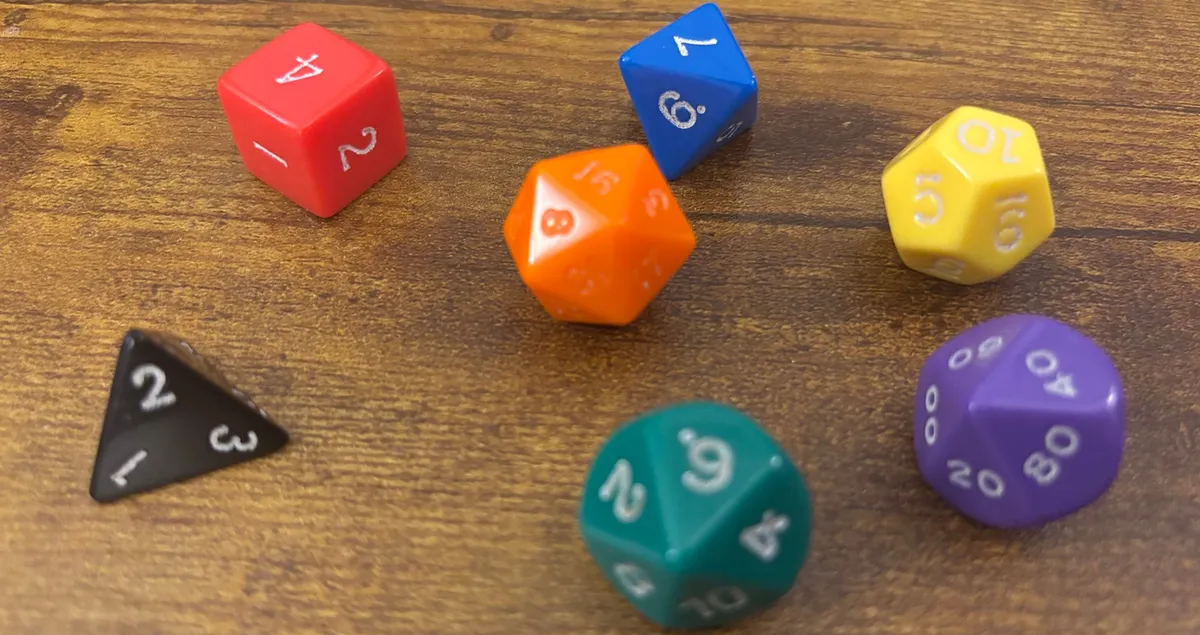
Many moons ago, when setting myself to the task of developing a post-apocalyptic TTRPG in the style of The Last of Us, I spent the better part of three months pilfering ideas from random rulebooks and playing around with anydice, trying to find the 'perfect' core dice mechanics for my fledgling game.
Spoiler: There was no perfect dice mechanic, and that 'game' is buried within a random collection of 5 year old google docs. Perfectionism kills!
There's a lot that goes into dice mechanic design. It's not everything; if PBtA is just 2d6+stat -> failure/mixed success/success, you've dramatically missed the point, as I once did. But it’s pretty important.
What got me thinking about all this again was Prismatic Wasteland's Random Blogwagon, which conveniently coincided with my finishing a Call of Cthulhu campaign, starting a Mythic Bastionland campaign, and running a introductory one-shot for a group of novices in D&D 5.5e.
All three of those systems (and their system families) have core dice mechanics that, when boiled down to their bare components, are mathematically more similar than they might seem at first glance. Some scaling and a flipped sign or two and you get the same thing. It’s how they're used and what they're compared to, typically at the most fundamental level of 'I want to do X, roll for it,' that I find really worth exploring. Do these dice mechanics support the gameplay each system sets out to create? Are they as fundamental as one might expect? Let's take a look.
The Universal Value of Variance
Of course, besides giving me a handful of plastic polyhedrons to fidget with until I inevitably shoot one under the gaming table, the primary function associated with dice is creating variance.
Well, pedantically, they create probability distributions, but applying said distributions yields uncertainty and variety in gameplay and narrative, which I'll unscientifically call 'variance' for now. There's also verisimilitude, as the outcome of any one action should be hard to know, though with each passing day I question the truth of this claim. Are people really so inconsistent? We'll get to that.
Now, humans love uncertainty. Well, actually sometimes we hate uncertainty. But we love gambling! Humans are weird. I'll at least say this - humans pay attention to uncertainty. It's engaging.
Something bad is going to happen to me? Well that sucks.
Something bad might happen to me?

I'm tempted to continue this line by claiming that uncertainty also enriches games by preventing 'solvable' situations. But it's at this point I'm reminded that this blog is about role-playing games...
Shall I delve into Bleak Falls Barrow next? Or perhaps get really good at... smithing daggers? Or any other of the infinite permutations between the two?
... and not closed-structure games, by which I mean strictly procedural and goal oriented ones, like chess or Magic: The Gathering. In Magic, that no player (usually) knows the next card to be drawn makes the game far more exciting.
On the other hand, remember Morrowind? You know, the third Elder Scrolls game?
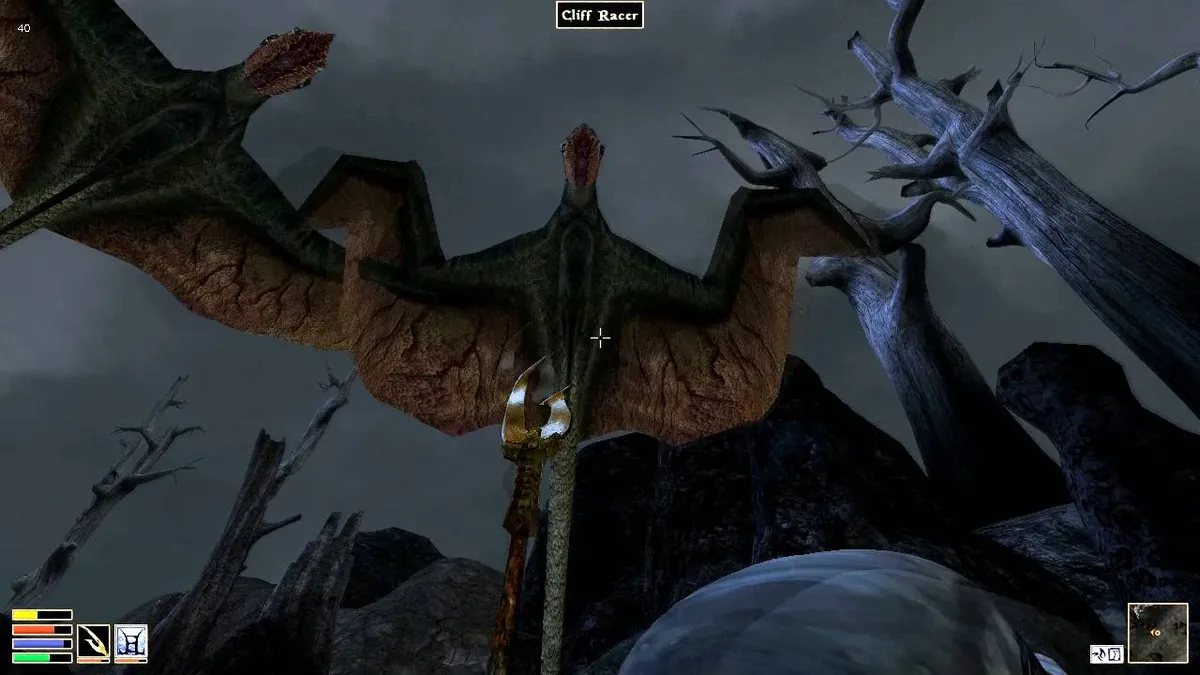
If you don't, it was the Belle of the 3D games Ball when it came out back in 2002. And incredible in a lot of ways that I'm not going to talk about right now.
One... other thing it did, like any good RPG of that era, was draw heavily from the TTRPG community that preceded it - in Morrowind, attacks had a percentage chance to hit. A reasonable mechanic; after all, that's how D&D worked, and it encouraged you to do RPG type activities, like putting points into the appropriate weapon skill and finding ways to get around enemies with good evasion.
But that mechanic also kinda sucked. The player is not a game designer. They are unlikely to appreciate the nuances of the hit rate and evasion formulas when facing down a pack of Cliff Racers. Click, swing, weapon model intuitively strikes enemy model, whiff sound effect. I am immediately taken out of the fantasy and now feel as though I'm wielding a pool noodle.
There's something about seeing your character 'do the thing' and still miss that's just jarring. You'd already done the all work! Why was there still a chance for failure?
Why does this feel familiar?
Funnily enough, this debate has returned home to the TTRPG community that spawned it. But this is a hard problem to solve! RPGs just aren't structured like 'normal' games. They're loose collections of experiences and imagined hypotheticals and simulations frankensteined together with a bunch of semi-connected mini-games. That's tough to apply theory to!
But... that also makes RPGs expansive. Even if you aren't playing in a sandbox campaign, the tactical infinity offered by most role-playing games provides all the variance once could ask for. And that's without dedicated uncertainty mechanics!
So do we need them?
And Now, Dungeons & Dragons
"Shut up nerd!" says the other, louder nerd. Rolling is everything in good ol' D&D baybee!!! Want to solve the mystery? Roll Investigation! Want to seduce that dragon? Roll Persuasion! Rolling dice feels good, and that's what we're here to do. Now watch this drive.

I kid. But D&D and its immediate relatives have a lot of d20 shaped nails, and your players are going to be itching to hammer them.
Like with broader game theory, a lot of the ground I could cover here is already explored by Vincent Baker's Fruitful Void, Luke Gearing's Mechanics as Abstractions, and Murkdice's 2 Axes of Abstraction.
To summarize, systems sometimes define exact procedures to abstract things away, so we don't spend too much time on them, because that's not what the game is about. Instead of drawing out a detailed map of the forest, we can just have you make a survival check and move on. If we actually wanted you to experience the forest in all its majesty, we wouldn't allow a single check to defeat it, we'd instead 'play it out' in conversation referencing all the other rules - that's Complex Judgement, or the Fruitful Void left behind when there aren't exact rules (or said rules aren't used) to resolve a specific situation. On the opposite end of the coded spectrum, if 50% of the rulebook is devoted to detailed forest traversal procedures, we're back to the part of the Abstraction Axes plot (Complex Rules) where the game is about survival again.
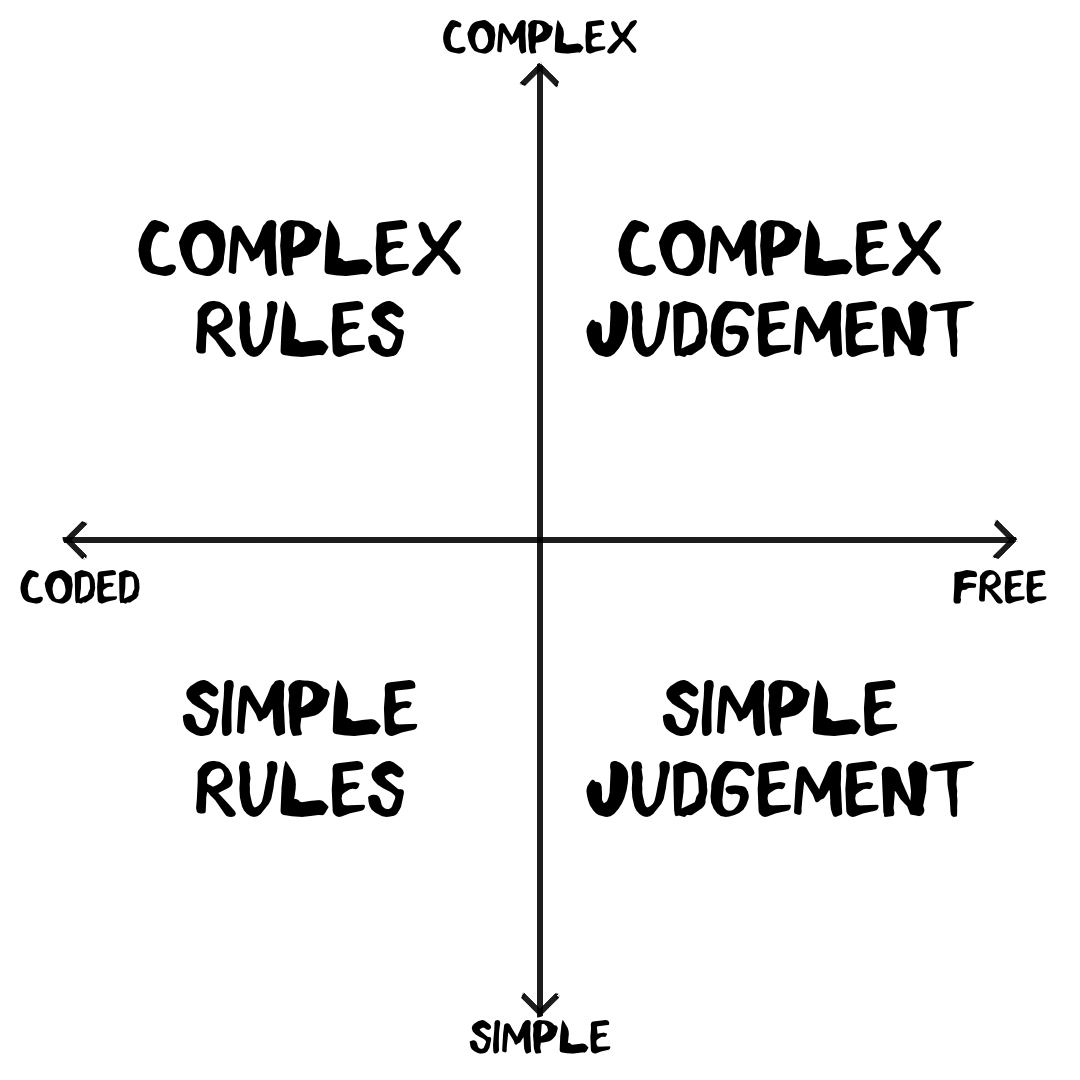
So, for now ignoring those situation specific rules (which oscillate all over the axes of abstraction), what do the core dice mechanics of a system tell us about a game's strengths?
In D&D 5.5e...
When the outcome of an action is uncertain, the game uses a d20 roll to determine success or failure.
You know the rest. Add modifiers. Compare to DC. Meets it beats it.
This all seems obvious, but there are already a number of assumptions at play here. With a few exceptions, the impact is binary and decided before you roll - either you get what you want or you don't - and barring combat crits, you can't modify that result based on how well (or poorly) you do; if you wanted more than originally 'wagered', you should've rolled against a different DC. Not quite fertile ground for variance. Many DMs react to the magnitude of the basic check anyway, implementing a sort of vague, vibes based 'degree of success' system which I actually like. But we're getting off track.
What gameplay is this core mechanic supporting? Well, unlike the other two games I'm writing about today, Dungeons and Dragons heavily encourages Buildcraft. Now, I like Buildcraft. But Buildcraft has a lot of design baggage.
Fundamentally, Buildcraft promotes specialization. Sometimes you either can or can't do something like cast Fireball, but for most features (skills, attack rolls, damage, etc...) specialization is incrementally tracked in constant (+1, +2) modifiers. Beyond democratizing potential access to success, (you can always try!) incremental specialization allows for greater build complexity - your species, background, class, equipment, feats, items, previous dealings with Mephistopheles, etc... can all contribute to your odds of success without each having a bespoke, individual mechanic to keep up with.
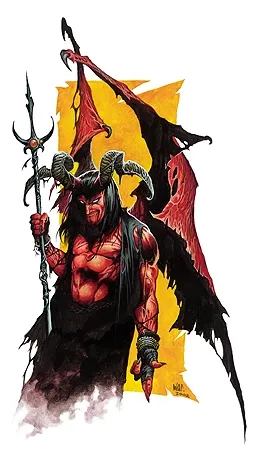
This also means we need a die with enough subdivisions to make the minimum bonus sufficiently small (1/20th of our random number generator should do the trick), and finally, we need to roll that random number generator a lot during play to reward those varied investments.
This has consequences. One I experienced recently was the classic 'roll at things to proceed' trap. No matter how much I plead that interaction with the fiction is the 'main' game, the piece of paper with the shiny, 'roll me!' buttons on it always has a way of hogging the spotlight.
Thanks for the flavor text, DM. Can I investigate at the mystery now?
I'm not knocking it! Rolling dice is fun. Being 'good' at investigation because the number on your sheet says so is fun! But without careful application, skill checks run the risk of becoming the game rather than supporting it - no Fruitful Void here.
Another issue is what you might call swingyness. No matter how perfectly a game's modifier system is designed, you're going to run into checks that feel stupid, or where the die matters way more than your skill or strategy. Tempted to lower the DCs for those checks to make them feel less random? Well now everyone can do it.
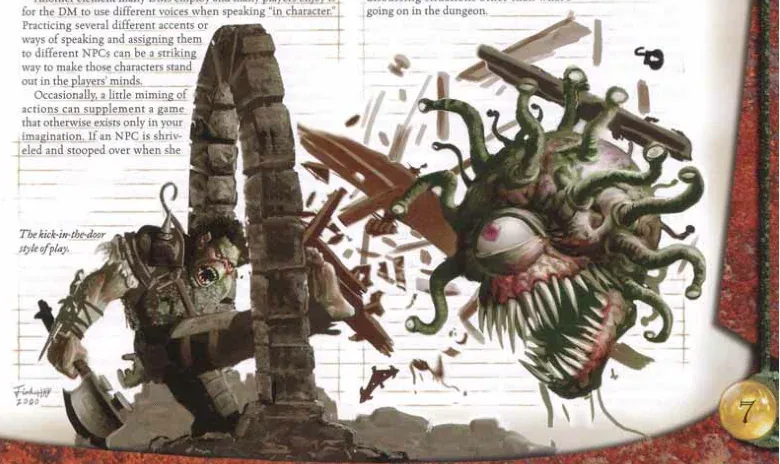
There are remedies, of course. Pathfinder 2e has Assurance and a much more rigid balance system (which, of course, has its own drawbacks). Shadowdark and many other OSR titles reduce or randomize opportunities for Buildcraft, and can thus afford to discourage rolling when it 'makes sense' for a character to be able to do something. Degrees of success and incremental progress (clocks) can also help spread the randomness across time! But as always with this damn game, without a lot of work, we're still stuck with the same old chassis.
Something a Touch More Odd
We can clearly get a lot of variance out of the gameplay soup of RPGs without turning to dice. And like whiffing in Morrowind, sometimes the variance added by dice is... bad. So... what if we rolled less? Moreover, what would happen if our customization options were all bespoke, individual mechanics?
What if we assumed all attacks hit?
What if we didn't even set DCs?
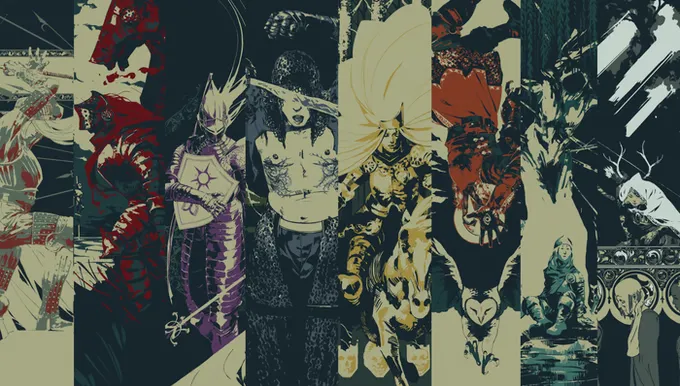
In Mythic Bastionland, you have three Virtues, each starting between 2 and 18. Roll a d20 equal to or under the appropriate Virtue to save, and you suceed avoid some negative consequence.
Honestly, I hesitate to even call that a core mechanic. I mean it is, but if anything, Mythic Bastionland's goal seems to be getting you to do anything but interface with the save system. Your Virtues are all over the place, and they keep going down with the attrition of play. Forget stacking modifiers, your goal is to avoid saves in the first place, and barring that, finding ways to take the edge off failure.
Coming from D&D and its ilk, the whiplash is immediate. But the lack of Buildcraft and fussing over modifiers immediately lets the player's attention be drawn away from their paperwork and towards the wonderfully weird world they actually came to interact with.
Notice that saves aren't necessarily about succeeding. So how do you proceed when 'the outcome of an action is uncertain' as D&D puts it? If I'm reading the Action Procedure correctly, I think I would say you're asking the wrong question.
The genuine, revolutionary thing, is that Mythic Bastionland (and its predecessors) simply aren't concerned with modeling probability. The question of interest isn't 'will it happen,' but rather, 'what would it take (leverage and cost) to make it happen'? Once that's established, only then might the Ref call for a save to avoid residual risk. Or just call it a Luck roll and model the remaining probability themself.
I do consider myself a simulationist to some degree, but maybe the focus on exact skill and probability is more of a Neil Degrasse Tyson-esque compulsion to fuss over details in media than a concern with modeling an internally consistent world. There's lots of room for making worlds more internally consistent, and most of them don't involve dice.
In contrast, Mythic Bastionland's dice fussing, primarily its save system, does... well, exactly what designer Chris McDowall wants it to do. Quoting Difficulty in Bastionland...
- Replace multiple rolls with one roll
- Replace rolls with interesting decisions
- Replace modifiers with dice variation
- Replace mechanical effects with diegetic effects
While this can take some getting used to (that's where I'm at myself) the core gameplay moves away from dice and towards freeform conversation - the glue holding RPGs together that may actually be the best part.
And to top it off, we've patched out whiffing at the proverbial Cliff Racer. Good job Chris!
Cthulhu's Closer
One last example, and I'll keep it short.
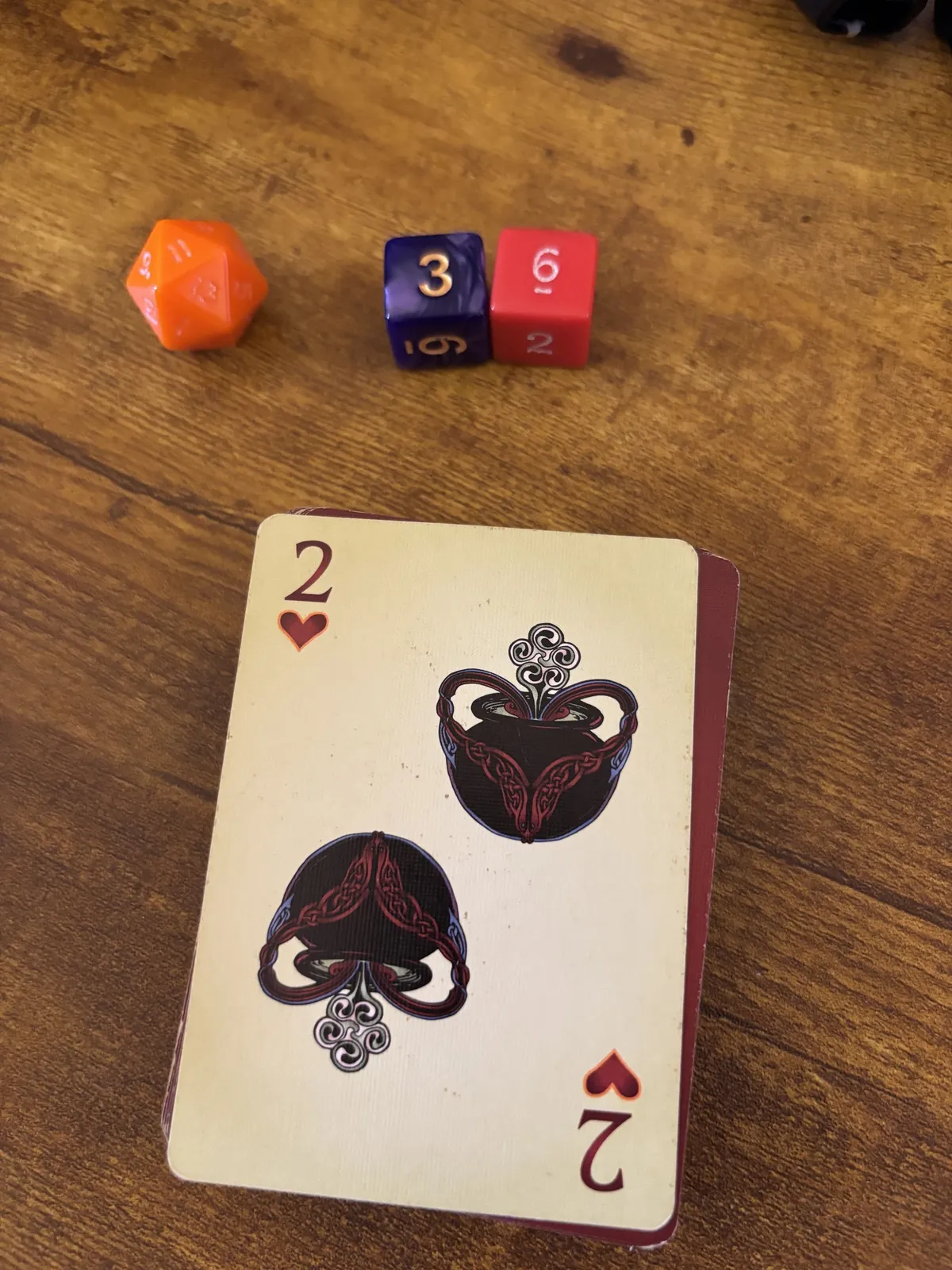
Forget about all that 'buildcrafting' and 'questioning the utility of dice' and 'meaningfully interacting with the game world' stuff for a second. Remember when I said sometimes we hate uncertainty? What if our design goal was just being really freaking scary?
How do we do that with dice? Risk. Mythic Bastionland already gets at this with its harrowing, 'the number is what the number is, shut up and roll' style saves. Call of Cthulhu, leveraging the Basic Roleplaying System, kicks on just a little more.
Like Mythic Bastionland, Call of Cthulhu is roll under relevant skill (d100 this time) and similarly unconcerned with fiddley bonuses. If something is easy, don't roll. But if something is hard, cut your skill in half, and if extremely hard, divide it by 5. The result is less clean than a straight penalty, but shrinks skill disparities as difficulty increases. In effect, this levels out the playing field when things go sideways. There's always a chance, but it's always slim.
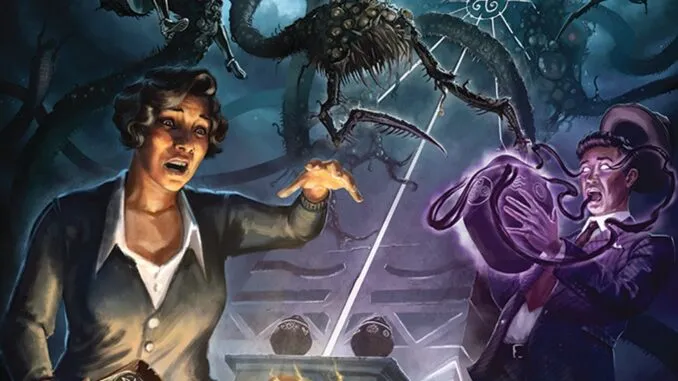
The real genius, thought, lies in the player counterplay systems. The first, Luck, a bank of points you can spend 1-to-1 to improve any roll, provides temptation and mounting dread unmatched by all but accumulating credit card debt.
The second is Pushing rolls, a reroll the player can opt into with the knowledge that a second failure dramatically ramps up the consequences. This is obviously great for drama, but also increases variance! Directly! One of my core frustrations with the d20 system is its lack of variety. You get it the thing or you don't. Big whoop. But with Pushing, those 'never mechanically described' moments where the hero's shirt gets caught on the door, or the car stalls, or worse (often much worse), can finally happen naturally.
I really can't praise either system enough. Truly mechanics worth stealing.
Where this Leaves Us
Look, I'm not quite ready to advocate for dice/coin/card/jenga-less systems yet; the rush of blood to the head from a good save or natural 20 still does something special. And I didn't touch even half of the cool stuff you can do with dice; there are plenty of areas (like the Luck roll) where they're due for more use. So if you take anything from this, I hope it's not to abandon our precious polyhedrons. But we should be wary of letting them gum up the most basic forms of play in a game-type already brimming with variety.
Perhaps unless you want every step to feel as unpredictable as the last. But like walking through downtown after a Mule parade, you might find you're more focused on your feet than taking in everything else.
Annndddd I forgot something. This last bit might not make any sense.
This may be random, but of course, we saved the best for last!
Want ultimate dice-based horror? The next time you play Call of Cthulhu, leave your pathetic 2d10-in-a-trenchcoat masquerading as a d100 at home.
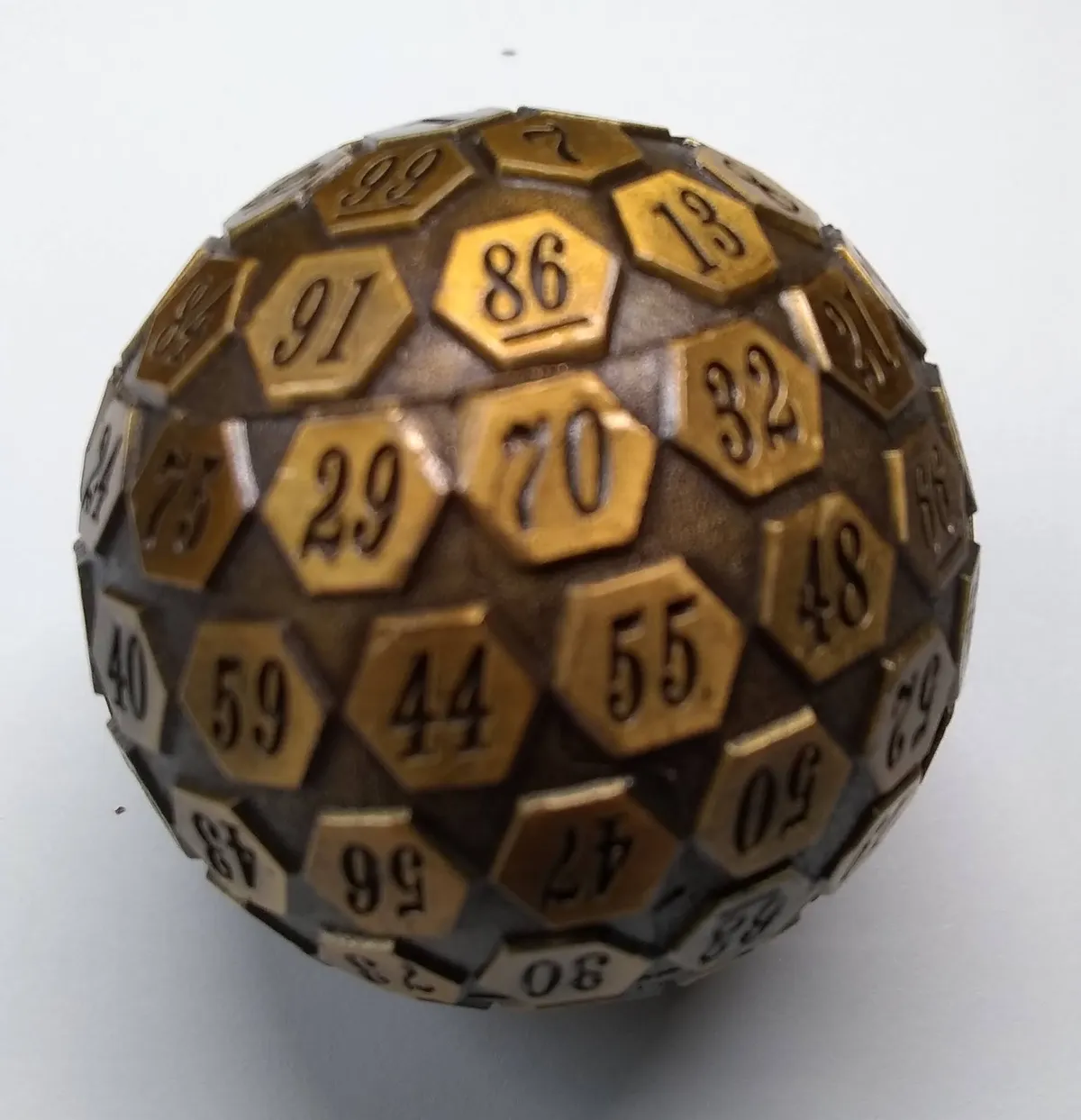
If you can find one, throw something like Gothridge Manor's massive gilded d100 at the table instead. Watch your host's face writhe in horror as they inspect the crater-sized dent it leaves behind. Now that's an impactful dice mechanic!