Making Other Magics - One Year of Indie TTRPG Design
Since November 2025, I've been co-developing a TTRPG called Other Magics. It's a game about wizards (though very, very different from another big game in development about wizards). This post is a recap of this first year of making our little wizard game, Other Magics, from inspiration to founding principles to playtesting. Let's start with the pitch.
Other Magics is an RPG themed around creativity, problem solving, and whimsical wizardly antics, inspired primarily by Mothership and Into the Odd. In Other Magics, players solve creative problems with an open-ended magic system, creating spells as they are cast using elements from the surrounding fictional environment.
The central conceit began with an idea (discussed by co-creator James here) after reflecting on an evening of indie gaming with Games on Demand at PAX Unplugged 2025. It started simple: what would a casual game almost exclusively about spell-crafting and casting be like? And more specifically, what if instead of trying to capture the vibes of magic - intricate rituals, component collection, sourcing dusty tombs, etc (here's Elmcat on how modern D&D fails at this) - what if it focused on the unique joys of creative problem solving by means of magic instead?
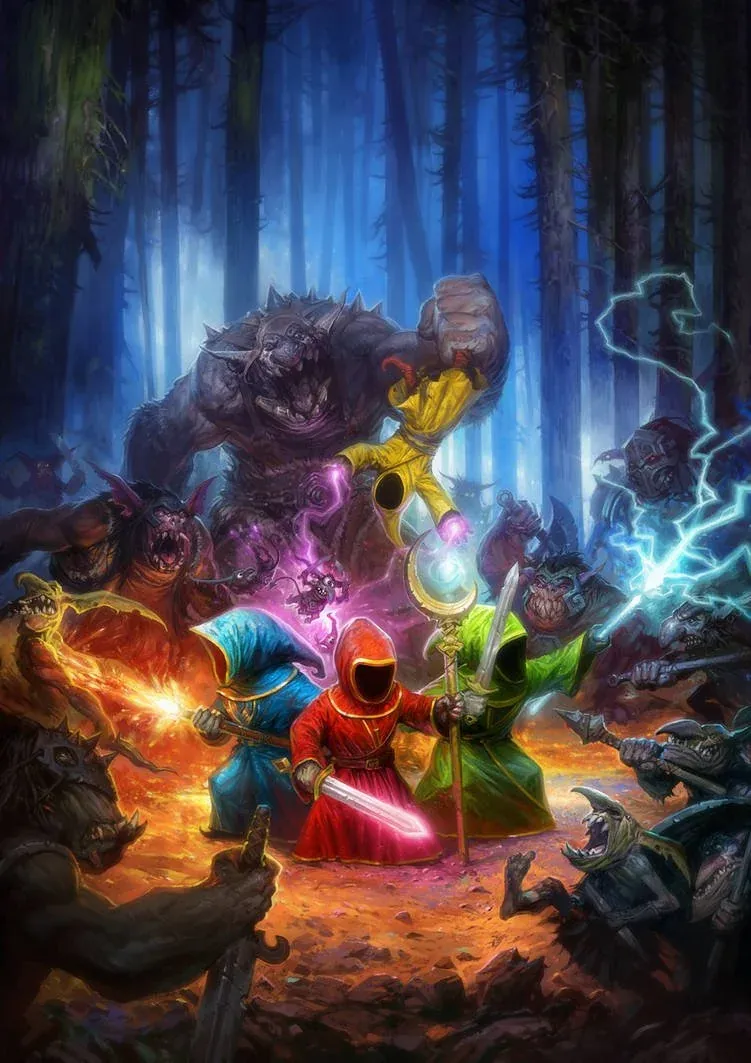
Basically, what if there was a rules-light, pick-up-and-play, interaction-focused TTRPG about wizards; wizards less like Gandalf and Mordenkainen, and more like the cast-from-the-hip, walking arcane experiments playable in the absurdly entertaining 2011 video game Magicka?
Put another way, if there's a specific joy we want to pin down, it's the one found in making harebrained schemes that 'might just work,' but also might spectacularly blow up in your face. This is well captured by the 'combat-as-war' mentality in the OSR, but for our imagined game that's about problem solving more broadly, it's even better represented in OSR style puzzles, challenges, and obstacles, especially (hence the aforementioned inspirations) the ones that appear 'naturally,' like when hiding from a space monster on a derelict space-station in Mothership or experimenting with vaguely-described, potent Arcana in Into the Odd.
Now, you, like me, may not be particularly fond of the 'puzzle' sections jammed into your favorite RPG, video or tabletop. My theory as to why is that many of these 'puzzles' boil down to guessing the singular 'right' answer the designer actually accounted for - think of the Gauntlet of Shar in Baldur's Gate 3, D&D riddles with only one 'correct' answer when many could feasibly work, or suggesting dinner options to someone who is pretending they don't already know what they want. These are often frustrating, I think, because they work backwards from or otherwise rely upon a presupposed solution. If you guess the answer quickly, it feels great, but if you don't, it sucks! A lot!
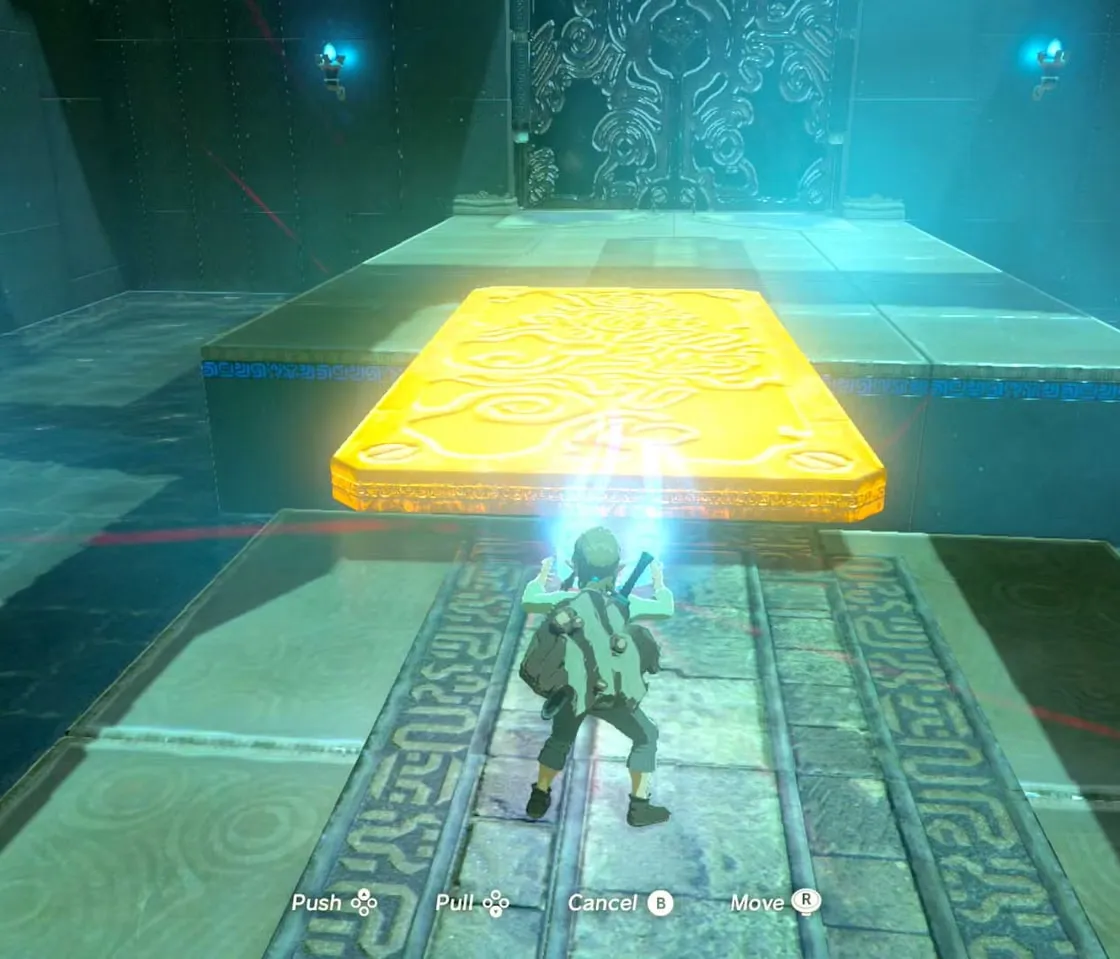
Some puzzles, however, like those found in Portal, a select few from Breath of the Wild, and particularly those championed by the OSR (Goblin Punch's list of 124 are the seminal source) abandon narrow solutions for interesting features and situations. Players are given toys (portal guns, Sheikah Slate Runes, ropes, caltrops, love potions) to unleash upon detailed, meaningfully-interactable environments containing innumerable features (whether explicitly stated, implied by the rules/situation, or improvised by a GM/Ref) which, importantly, aren't only there for the sake of encouraging a specific solution.
This approach to 'puzzles' or challenges or obstacles is foundation to OSR play and aligns with other OSR maxims fairly well, especially if you begin to understand a solution-first 'puzzle' as equivalent to preparing a 'plot' and a feature-first puzzle as to preparing a 'situation.' The point is getting away from overwrought, singular designs and into a space where conundrums spawn without trying, popping in-and-out of existence during play as the players' strategies, approaches, and goals shift, creating and erasing each-other like zooming in and out of a fractal.
Which brings us to back Other Magics. What would a system designed to encourage open-ended, 'naturally-occurring-puzzle solving' play from the ground up look like? And what if the players have design-derailing magical powers from the jump? Can puzzles, heck, games in general, still work in such an environment? We think yes. Very well in fact! Let's see how.
Foundational Principles
The first (underrated) step in design was being specific about what we wanted, (thanks for the inspo, Matt!) which provided an invaluable set of 'north stars' to guide us through the design challenges we encountered down the line.
Sparse, Flexible, Widely Applicable Rules - Other Magics is not a fantasy heartbreaker meant to scratch every possible itch in RPG gaming. What it needs are enough rules to turn a contrived, amorphous conversation about imaginary wizards into something with enough structure for players to interact and strategize with, while not giving it so much structure that play is bogged down or limited to that which the rules explicitly describe.
Emphasis on the 'Reality' of the Fiction - If gameplay is about problem solving, we need to ensure the problem at hand exists in the shared imaginary game world, not in the rules scaffolding it. Moreover, we simply can't make and explore engaging, open-ended situations without situating them in a feature rich space; a ruleset alone can never provide enough detail to make up the difference. Thus, design needs to regularly reference the fiction and enforce its importance and authority. In Other Magics, if it should happen in the fiction, it should happen in the game!
Unbiased GM/Ref/Adjudicator Discretion - If we're going to rely on it to steer structure and consequence, the Adjudicator (working title for primary game runner/facilitator) needs to know how to resolve and update the fiction in a satisfying way over the course of play. This guidance shouldn't always be more rules, but it needs to be more than 'vague GMing advice' if the game is to feel fair and sufficiently 'real' to the players; again, the problem that players are trying to 'solve' should lie within the imagined game world, not in the rulebook, nor in bartering with the Adjudicator.
Empowered Players - Creativity is spurred by limitation, which is the driving force behind many low-power, 'ropes, caltrops, and a handful of hitpoints' style OSR games. However, Other Magics, especially as it isn't optimized for longer, campaign style play, wants to start with as much uninhibited, reckless impact as possible from the jump (while retaining sufficient limitations to keep creative strategy necessary). Spells and situations should often go awry; players need the power to fix those runaway disasters (or trigger new ones) from the start to the end of play.
From Principles to Sick Wizard Spells
Alright, so how do you, uh, do all that? Well, that's the question James and I have been asking ourselves, each other, and our play testers almost every week this year through brainstorming, playtesting, interrogating the players, revision, more playtesting, more interrogations, and so on, all in accordance with Jay Dragon's Three Secrets of Making Games.
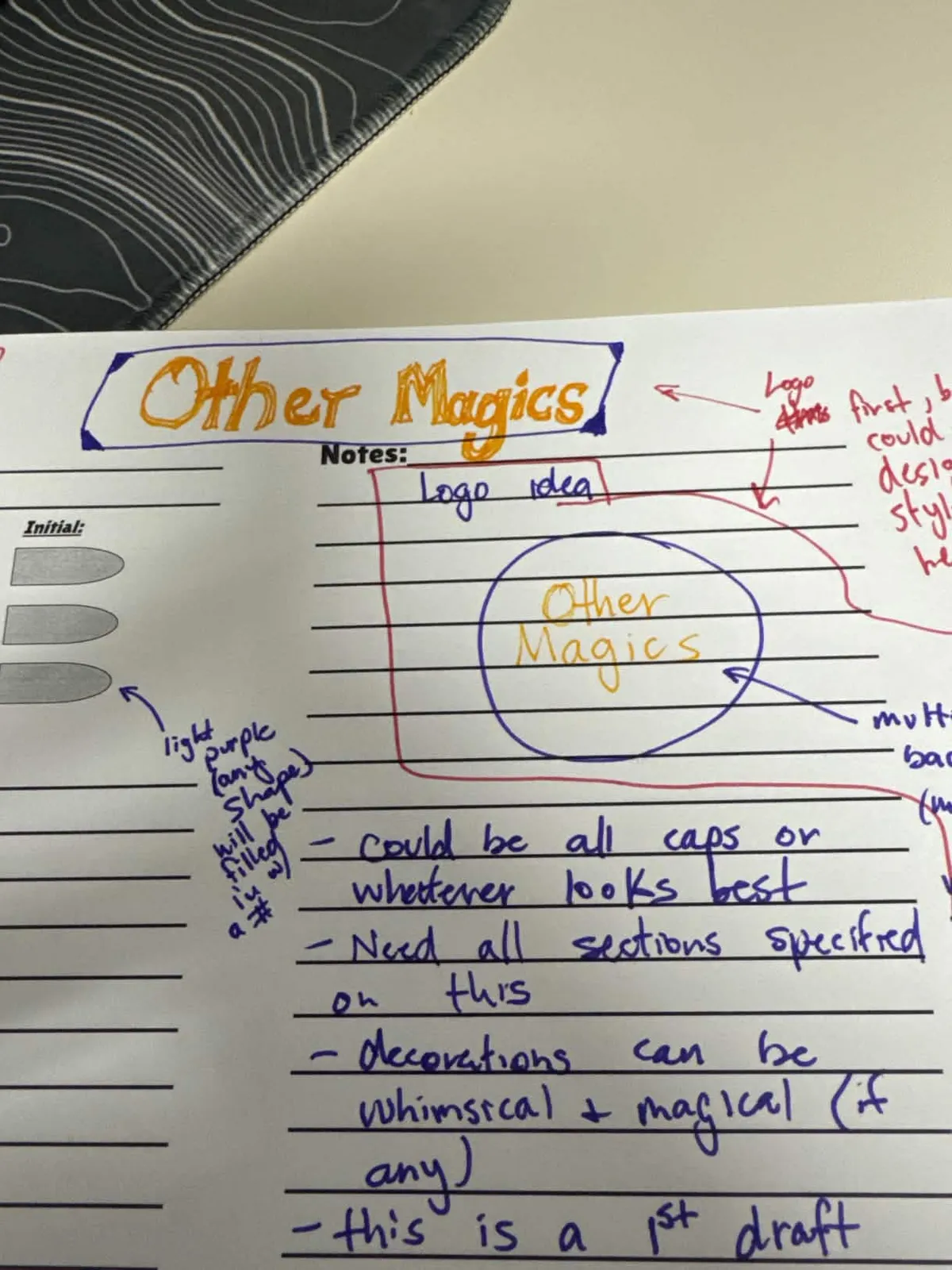
After much work, this process finally solidified the central facet of wizardly gameplay: the anatomy of an Other Magics spell.
Other Magics takes a semi-solid approach to magic - the power and flexibility of spells, which are the primary way the player interacts with the game world, should be limited enough to encourage strategy and teamwork but flexible enough to retain creativity and a wealth of valid options. To achieve this, all spells are, well, made up on the spot to fit the needs of the situation. But they're limited in scope by...
The caster's Class, like the Artificer, who can only bring things into existence, or the Kineticist, who can only push existing things around.
A channeled Essence, which is a fundamental and specific property like Fire or Orangutan the caster previously collected by finding an example of said Essence in the environment. The channeled Essence determines the 'object' of the spell - what it brings into existence/moves around/or otherwise 'does' depending on the Class.
The result of the caster's die roll, which determines if the caster's magic actually does what was intended or not, adjusted by the spells' ambition and situational miscellany with a modified roll under stat system inspired by Into the Odd.
There is a healthy amount of wiggle room for players and Adjudicators throughout - even in the dice rolls, which leave the door open for Burning, an in-for-a-penny, in-for-a-pound 'sacrifice-to-succeed-anyway' system inspired by the Luck mechanic of 7e Call of Cthulhu. Running rounds inspired by Mothership's simultaneous combat approach helps keeps things flexible and team-oriented as well, but at the risk of regurgitating the rest of what has been deemed ready for the digital light of day, I'll leave it by encouraging you to check out more specifics at the Introduction to Other Magics. For today's purposes, the broader ideas are what matters. Class limitations heavily encourage spellcasting teamwork. Need something specific to exist, and need to get it somewhere fast? You need an Artificer and a Kineticist! Want more spellcasting options? Then pay attention to the game world and find more Essences! Need some magic to do something specific, but the rules don't include a prepackaged option that describes exactly what you need? They never will, so make something up!
Other Magics in the Field
Somewhat surprisingly, playing a game with the core mechanic of 'just making something up' (within reason/limitations of the rules) has actually worked quite well, even for players more used to the strictly mechanical spells of D&D and Pathfinder.
It hasn't all been perfect, of course.
- In playtesting, we've seen games bogged down by circular discussions and excess strategizing about the idea of casting spells, which is especially useless when said spells and the game at large are so volatile.
- Class descriptions (particularly the less intuitive Transmuter and Enchanter) have been tightened and re-tuned after a number of (mostly harmless) misunderstandings and identification of some features which were, despite trying not to worry too much about such things, a little too
powerfuluniversally useful. - And don't even get me started on adjusting dice and modifier math.
But there is plenty to be excited about too; to be honest, quite a bit more than we expected, even with modestly optimistic expectations.
Despite bracing for it, we were surprised to see that open-ended, high powered magic rarely encouraged looking for exploits and 'spells-of-I-win', perhaps because in a game like Other Magics, what would normally be an 'exploit' just seemed like a clever idea.
Designing missions - typically trope-y, genre-spanning expeditions ordered by the mysterious, inter-dimensional wizardly organization called the Library - was actually a fair bit easier than prepping a traditional session of something like D&D from scratch. You don't really need to be a master puzzle crafter either; simple (though challenging, these are wizards after all) obstacles with lots of interactable parts and without obvious solutions did the trick every time.
While it made session length and direction hard to predict, players also seemed to appreciate playing (and running!) those feature dense, low structure missions with problem-solving at the forefront, even when combat and narrative plot, the bread and butter of traditional TTRPG play, took a back seat.
Most excitingly, several playtesters who had written off TTRPGs as tedious, non-engaging, or overwhelming described this playstyle as one they finally enjoyed! I suspect this is in part due to the still-limited spread of the OSR/NSR style to the wider masses, but we'll take the credit nonetheless!
All told, it's been a productive first year. The core chassis is essentially done! And there's an Adjudicator's Guide, comprehensive (as it can be, anyway) Core Ruleset, and a set of five playtested, custom missions. But there's still much to be done. And if you, reader, are interested, we'd love for you to be a part of that process.
First, if you're attending PAX Unplugged this year, you can find me (Luke) and co-designer James at Games on Demand, where you might get a chance to play the current version of the game with us, or talk at the Designer Meet and Greet, or briefly make eye-contact in the hallway, or something. We'll also try to make Exeunt Press's Indie Self-Published Meetup. More information on all of that here.
Otherwise, if you're interested in future playtesting, we have a interest form!
Finally, if you're interested in keeping up with development, keep an eye out at the Other Magics blog/website and Bluesky. And here at Atmospheric Underworld too, of course, for deeper, more philosophical dives into the design process in addition to my (usual?) nonsense. And perhaps an explanation of why I keep using Orangutan as the defacto Essence example. We'll see! Keep your ears to the ground, either way.